

From Scan to Scale: Insights on Reality Capture and Industrial Digital Twins
/At Industrial IMMERSIVE 2025, the session “Industrial Digital Twin & Reality Capture Workflows: Building From Data Capture to Model at Scale” brought together five experts to unpack the evolving digital twin landscape—and what it really takes to scale these technologies across industrial environments.
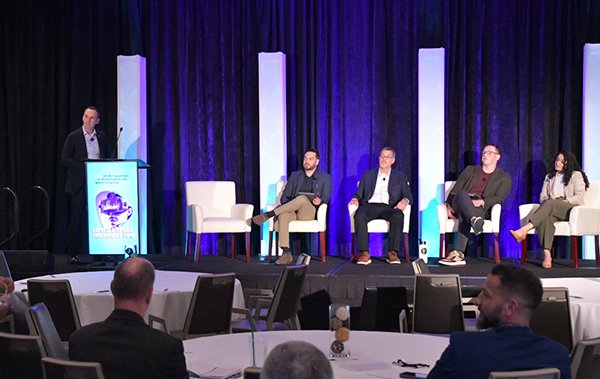
Moderated by Kevin O’Donovan of A Bit of This & That, the panel featured:
Marco Gonzalez, FARO Technologies
Dan Isaacs, Digital Twin Consortium
Casey O’Connor, VectorNet
Nikhat (Nikki) Poonawala, Worley Limited
While the conversation spanned technologies, ROI, workflows, and AI, a few recurring themes stood out: trust in data, purpose-driven digital twins, and the need for clear end goals.
Scaling Begins With Purpose
One of the clearest messages from the panel was that successful digital twins don’t start with a scanner or a software tool. They start with a question: What are we trying to solve?
“Don’t just ask for a point cloud for a point cloud,” said Casey O’Connor. Creating an industrial digital twin that delivers real ROI isn’t just about scanning and storing data—it’s about aligning the data strategy with a clear business problem.
Dan Isaacs emphasized the point, saying: “It’s really about what is the problem you’re solving… Let’s figure out the most appropriate technology, the most appropriate strategy to address that problem. That’s where you recognize that true value.”
Nikhat Poonawala added, “Start with the end in mind. So before you say we’re going to build this new asset, well, what’s the goal? How do you want to run it?”
Reality Capture: More Accessible, But Still Not Plug-and-Play
Reality capture tools—from mobile scanners to high-fidelity terrestrial scanners—are becoming easier to use. But ease doesn’t mean simplicity. The panel warned against turning scanning into a “button pusher” exercise.
“It is getting easie—basically anyone can scan, operate the scanner, and process the data,” said Marco Gonzalez. “But we encourage the customer to take formal training prior to using our devices and software to get the max benefit.”
O’Connor also underscored the risks of unplanned data collection. “You really have to cause friction early and often… ask what the data is going to be used for, because not everything needs scanned down to a millimeter, but some of it does.”
Data Is Only Useful If It’s Trustworthy
In industrial digital twin development, data isn’t just king—it’s the whole court. But as the panel emphasized, reality capture data only delivers value if it's accurate, timely, and traceable. Without context, even the most detailed point cloud can mislead.
Reality capture is only as valuable as its metadata. Who collected the data? When? With what tool? Was it registered on survey control?
“Anytime you're going to collect data, it's got a shelf life,” O’Connor said. “You need to make sure that you're not duplicating data and you really need to pay attention to when it was captured.”
That’s especially critical for engineering services firms like Worley. Poonawala said, “Without the actual reality capture data—without understanding friction points or where there's process lags—it’s hard for us to even say we are doing our best job for our customers”.
So how do you maintain trust in data across stakeholders?
Prioritize Metadata and Source Tracking: Project stakeholders must know not just what the data is, but where it came from—and under what conditions.
Align Data Capture with End Use: Data shouldn’t be captured in a vacuum. Panelists stressed the importance of pre-planning, starting with the question: What is the data going to be used for?
Use the Right Tool for the Job: Many customer issues stem from using the wrong scanner or settings for a given job. Match the scanner to the project requirements—mobile scanners for speed and coverage, terrestrial scanners for precision.
Build in Quality Assurance from the Start: Follow established accuracy benchmarks, and include metadata like location, purpose, and tool, which gives lasting utility beyond the initial capture.
Enable Ecosystem Collaboration: Reality capture data should be shared across the lifecycle, not siloed within departments or vendors. Lack of access can limit how well teams can design, validate, and improve assets.
Modeling Isn’t Always the Answer
There’s a common misconception in the world of digital twins: if you’ve scanned it, you should model it. But several panelists pushed back on that assumption, warning that excessive or unnecessary modeling not only adds cost—it can also introduce error.
“We're not really advocates of turning point cloud data into models unnecessarily because it's inaccurate,” said O’Connor. “We live in a very imperfect world, and to apply perfect parametric graphics to point cloud data, you're immediately introducing inaccuracies.”
Instead, O’Connor advocated for a practical, use-case-driven approach. He pointed to ExxonMobil, which manages its spatial data using point clouds and meshes as the authoritative record, only creating detailed models when needed for new design or engineering work.
This shift in mindset—from “model everything” to “model what matters”—was echoed throughout the panel.
AI & Automation: Not There Yet, But Close
No panel in 2025 would be complete without an AI question. The consensus? AI is poised to speed up reality capture and decision-making, but it’s not a magic wand.
“AI will get us to being able to get actionable insights from raw point cloud data faster,” said O’Connor. “It's speeding up quite a bit, but it's going to get even faster.”
Isaacs sees AI and digital twins intersecting even more deeply in the future. “Generative AI is going to force increased levels of autonomy as the digital twin evolves,” he said, especially when it comes to multi-agent systems where the digital twin acts as the proxy to the real world. “That’s going to drive the accuracy and the precision even more.”
AI isn’t just for automation or analysis. Poonawala brought a sustainability lens to the conversation, describing how AI can support decarbonization efforts by generating more—and better—design alternatives. She said, “What I see is the ability to give us options in lots of different ways—options for design, options for carbon reduction.”
But she also pointed out the irony: “You want to use AI so you can get better at optioneering, but AI uses a lot of the resources that we're also trying to limit. So there's a balance there that I think we need to figure out.”
Common Mistakes (and How to Avoid Them)
The panel wrapped up by offering practical advice for anyone starting their digital twin journey:
Poonawala: “Operators need to push services companies to deliver digital twins—not just raw data.”
O’Connor: “Too many people in the room with too many opinions. Pick one real business problem and prove the value first.”
Isaacs: “Don’t start with the data. Start with the problem.”
Gonzalez: “Field data capture is where it all starts. Use the right tools and best practices to avoid issues down the line.”
A Final Word: Define the Problem First
If there’s one message the panel wants attendees to walk away with, it’s this: Don’t start with the tech. Start with the problem.
As Isaacs put it, “Jumping into it and saying, ‘Okay, I want a digital twin for this’—that’s not the approach.” Instead, start with the problem. Know your data. Choose the right capture method. And build with the end in mind.
Digital twins aren’t just 3D models. They’re strategic assets—and scaling them requires a clear purpose, trustworthy data, and the right tools for the job.
Want more where this came from? Watch the full session, along with other Industrial IMMERSIVE sessions, on demand.
And block off your calendar June 22-24, 2026, in Houston, TX, for the Industrial Digital Reality Summit (formerly known as Industrial IMMERSIVE).
